Milestones in Lunar Exploration for Water
1950
1960
Polar Lunar Ice from Hopping Water Theorized
1961
Credit: Caltech
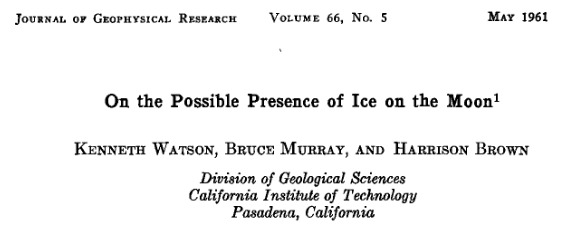
At Caltech, Watson, Murray, and Brown proposed that the Moon's permanently shadowed regions would serve as "cold traps", capturing and sequestering against loss to space the H2O molecules that arrived at the Moon's surface (either by eruption of lava or meteorite impact).
Apollo Program
1969-1972

Credit: NASA
The Apollo Lunar Program landed several human astronauts on the Lunar surface and returned them to Earth. Together, the missions acquired and returned over 370 kg of samples from the lunar regolith. Compared to Earth materials, lunar rocks are very old and exceptionally 'dry'. These samples form the basis for ongoing study of lunar surface and geologic properties.
1970
Potential Sources for Lunar Water Have Been Proposed
1979

Credit: LPI/Kring
Arnold (1979) proposes four potential sources of Lunar ice: solar wind reduction of Fe in regolith, H2O-containing meteorites, comet impacts, and degasssing of water from the Lunar interior. Destructive mechanisms in the form of photodissociation and decomposition by solar wind were also proposed.
1980
1990
First Polar Ice Deposits Discovered on an Airless Body (Mercury).
1992

Credit: Goldstone/VLA Slade
Earth-based radar images of Mercury show highly-reflective units at the poles, consistent with ice deposits (Slade et al., 1992), observations later confirmed by the MESSENGER mission. This reignites interest in the potential for polar ice on the Moon (Ingersoll et al., 1992).
Lunar Prospector Finds Evidence for Water at the Lunar Poles
1998

Credit: NASA/Lockheed/LANL
The Gamma Ray Spectrometer (GRS) on Lunar Prospector detects increased hydrogen abundance in areas that are spatially consistent with permanently shaded regions at both Lunar poles. The most likely source for hydrogen at these locations is interpreted to be water ice beneath a thin layer of regolith. (Feldman et al., 1998).
2000
Examination of Moon Rocks with Modern Instruments Finds Lunar Mantle Water
2008

Credit: HIGP/GJ Taylor
Saal et al. (2008) re-examined Apollo volcanic glasses taking careful profiles of water abundance across individual grains. They show waters increase from rim to the core, suggesting the bulk magmas from which glasses formed were not depleted in water. Instead, parts of the Moon's mantle may hold 100s of ppm of water, similar to Earth's.
M3, Cassini VIMS, & EPOXI Data Suggest Presence of Water (H2O/OH) on the Moon
2009
Credit: ISRO/NASA/JPL-Caltech/Brown Univ./USGS
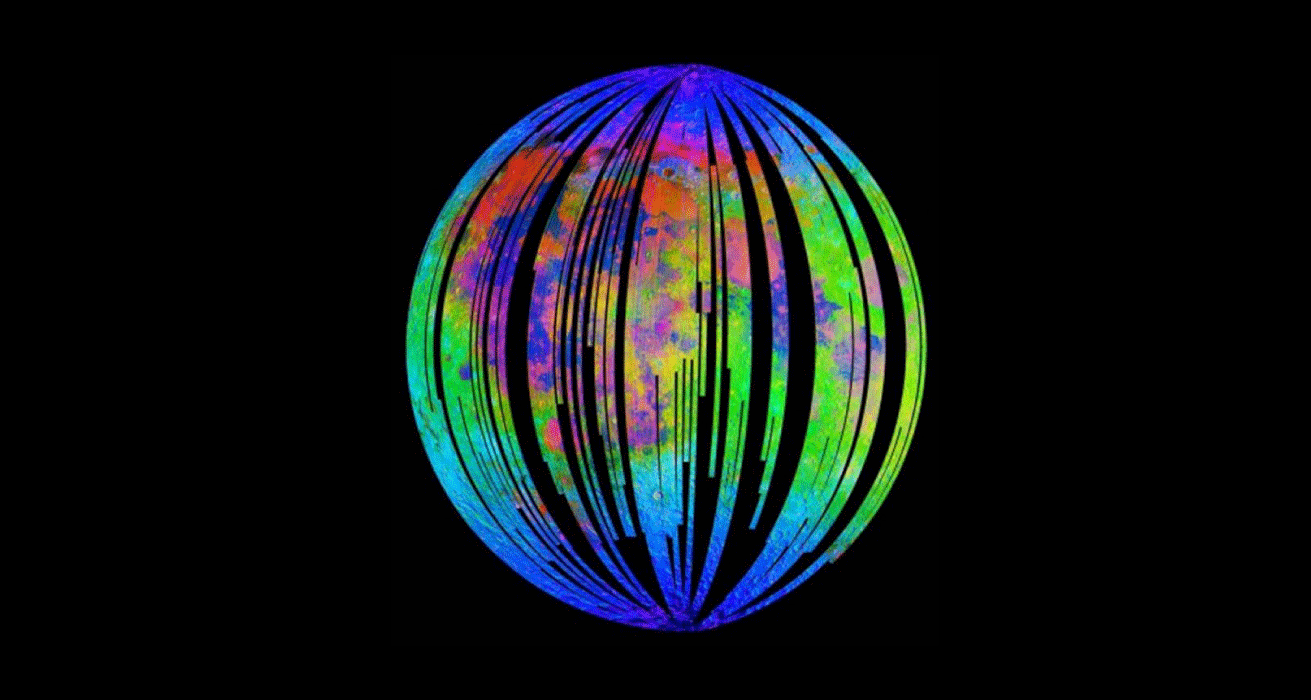
M3 (Moon Mineral Mapper) on Chandrayaan-1 detected absorption features near 2.8 to 3.0 micrometers on the surface of the Moon. The feature is seen as a widely distributed absorption that appears strongest at cooler high latitudes and at several fresh feldspathic craters. The general lack of correlation of this feature in sunlit M3 data with neutron spectrometer hydrogen abundance data suggests that the formation and retention of hydroxyl and water are ongoing surficial processes. Hydroxyl/water production processes may feed polar cold traps and make the lunar regolith a candidate source of volatiles for human exploration (Pieters et al., 2009)

Credit: NASA/JPL/UCLA
Clark (2009) recalibrated low spatial resolution data by the Visual and Infrared Mapping Spectrometer (VIMS) on Cassini during its flyby of the Moon in 1999. This new analysis revealed broad absorptions at 3 and 2.8 micrometers, attributed to water and hydroxyl on the sunlit surface on the Moon. The amounts of water indicated in the spectra could be 10 to 1000 parts per million and locally higher. Trace amounts of hydroxyl were observed in the anorthositic highlands at lower latitudes.

Credit: NASA/UMD
During an Earth-Moon fly-by, EPOXI low spatial resolution measurements were found to have < 0.5 weight percent H2O at the lunar poles. Hydration varied with temperature, and comparisons between data collected a quarter lunar day apart showed diurnal changes in hydration that were greater for mare basalts than for highlands (Sunshine et al., 2009).
First Thermal Maps of Lunar Polar Cold Traps by LRO/Diviner
2009

NASA/JPL/UCLA
First maps from orbit returned by the Diviner radiometer on NASA's Lunar Reconnaissance Orbiter show that the Permanently Shadowed Regions (PSRs) at the lunar poles have temepratures well below -173 C (100 K) that can serve as cold traps for water.
2010
LCROSS Impacts a Lunar Area in Permanent Shadow, Briefly Creating a Plume of Diverse Volatiles.
2010

Credit: Caltech
The LCROSS mission (the expended centaur stage) impacted Cabeus crater, a permanently shadowed region of the Moon, on October 2009, while both the sheparding spacecraft (with 9 instruments) and LRO (Lunar Reconnaissance Orbiter) observed the impact and resulting plume for evidence of a H2O and OH. Colaprete et al. (2010) and Schultz et al. (2010) show that the plume of impacted debris hosted diverse volatiles, likely sequestered together on the lunar surface.
Radar Measurements of the Lunar Poles are Ambiguous
2010
Spudis et al. (2010) discuss Chandrayaan-1 lunar radar measurements of the poles (generally similar to those for Mercury), but do not detct comparably thick ice deposits.
Lunar Water Proposed to Have Been Delivered by Comets
2011
Greenwood et al. (2011) use hydrogen isotopic evidence in Apollo rocks (specifically apatites) to support idea that much of the lunar water came from comets shortly after the Moon-forming impact.
KISS Workshop on Lunar Ice Detection and Mapping
2013

Credit: KISS
Paul Hayne, Andy Ingersoll, and Dave Paige lead a Caltech Keck Institute for Space Studies think-do tank study of novel methods for accessing lunar ice. One of the recommendations is that cubesats may play a role. This workshop was an early seed for Lunar Trailblazer (final report.pdf).
Direct Detection of Ice in Permanetly Shadowed Regions
2018

Credit: NASA
Li et al. (2018) detected absorption features due to water ice in M3 near-infrared reflectance spectra from multiple permanently shadowed regions, the cold traps in polar craters that never receive direct sunlight. These Moon Mineralogy Mapper (M3) detections required measuring reflections of light from surrounding terrains as no direct sunlight falls on the deposits. Lunar Trailblazer will use a similar approach to peer into shadowed craters to search for ice at even smaller scales.
Lunar Trailblazer Proposed as Candidate Mission for the SIMPLEx-2 NASA Planetary Small Satellites Call
2018

Credit: Lunar Trailblazer
The mission was one of more than 12 proposals submitted through an opportunity called the Science Mission Directorate (SMD) Small Innovative Missions for Planetary Science (SIMPLEx). Using small spacecrafts less than 400 pounds, SIMPLEx selections conduct stand-alone planetary science missions, sharing their ride to space with larger missions or commercial launch opportunities.
Lunar Trailblazer Selected as a NASA SIMPLEx Mission
2019

Credit: Lunar Trailblazer
The project is one of three finalists selected for the SIMPLEx call for low budget missions capable of major planetary surveys.
2020
Lunar Trailblazer Rideshares with IM-2 Launch
2023

Credit: Lunar Trailblazer
Lunar Trailblazer will launch as a secondary payload on Intuitive Machines 2 (IM-2), taking the next steps in understanding the origin, distribution, and nature of lunar water.
2030
3D Image Credit: NASA/LRO/LOLA/JPL-Caltech
Do you have feedback for our timeline or an idea for an additional entry? Let us know!